Building a BLE Application with Zig and BleuIO: Reading Sensor Data from HibouAir

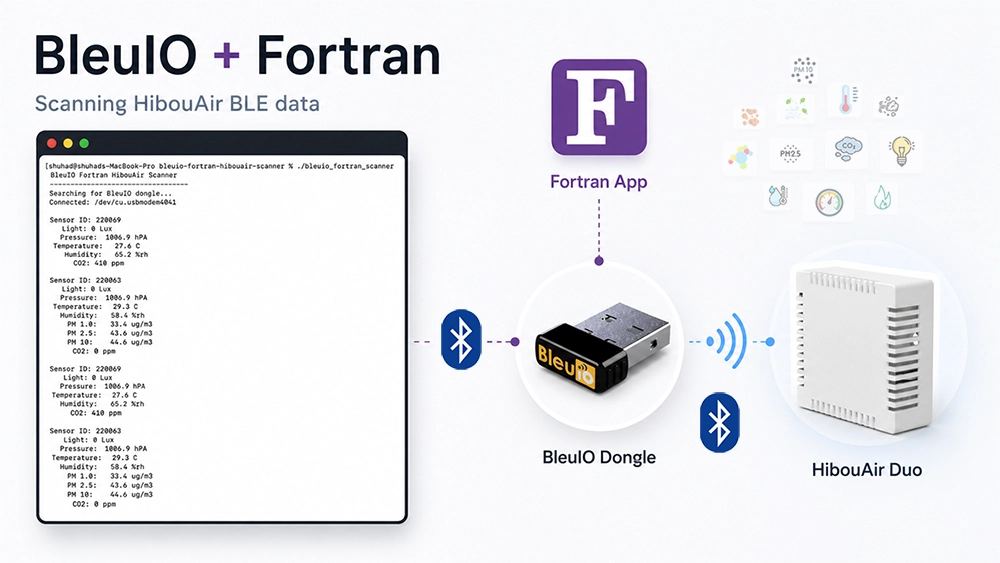
In this tutorial, we will build a lightweight command-line application that interacts with Bluetooth Low Energy (BLE) devices using Zig and a BleuIO USB dongle. The application will scan for nearby BLE advertisements and decode sensor data broadcast by a HibouAir device. While HibouAir is used here as a test case, the main goal is to demonstrate how BleuIO simplifies BLE application development and how Zig can be used to build efficient, low-level tools for working with wireless data. By the end of this guide, you will have a working example of a BLE-powered CLI tool that reads, processes, and displays real-time data directly in your terminal.

About ZipLang (Zig)

Zig is a modern systems programming language designed with a focus on simplicity, performance, and control over hardware resources. It is particularly well-suited for applications that require direct interaction with devices, such as serial communication and embedded systems. In this project, Zig is used to communicate with the BleuIO dongle over a serial interface, process incoming BLE scan data, and decode raw payloads into meaningful values. Its minimal runtime and explicit design make it a strong choice for building reliable BLE tools without unnecessary abstraction.

Project Requirements

Hardware

Software

  • Zig installed
  • libserialport
  • pkg-config

How It Works

The application uses BleuIO as a bridge between the computer and BLE devices. When the program starts, it automatically detects the connected BleuIO dongle by matching its vendor and product ID, then opens a serial connection configured for communication. Once the connection is established, the program sends AT commands to initialize the dongle and begin scanning for BLE advertisement data that matches a specific identifier used by HibouAir devices.

As BLE data is received, the Zig application continuously reads the serial output, interprets the incoming JSON responses, and extracts the relevant payload. This payload is then decoded into human-readable sensor values such as temperature, humidity, pressure, particulate matter, and CO2 levels. The decoded information is printed directly in the terminal, allowing real-time monitoring without requiring any additional tools or manual decoding steps. When the program is stopped, it gracefully sends commands to halt scanning and reset the dongle before closing the connection.

Source Code

You can find the complete source code for this project on GitHub:

https://github.com/smart-sensor-devices-ab/bleuio-ziglang

Install and Run the Project

Follow the readme file inside the project to install and run. Once dependencies are installed, follow these steps:

Build the project

zig build

Run the application

zig build run

Make sure your BleuIO dongle is connected before running the program.

Example Output

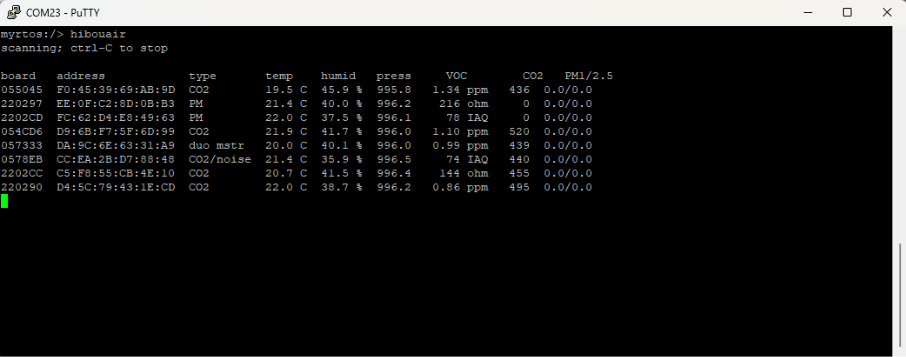
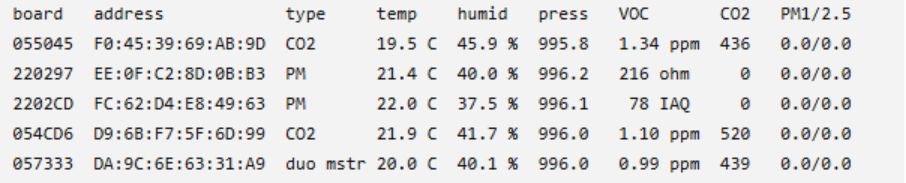
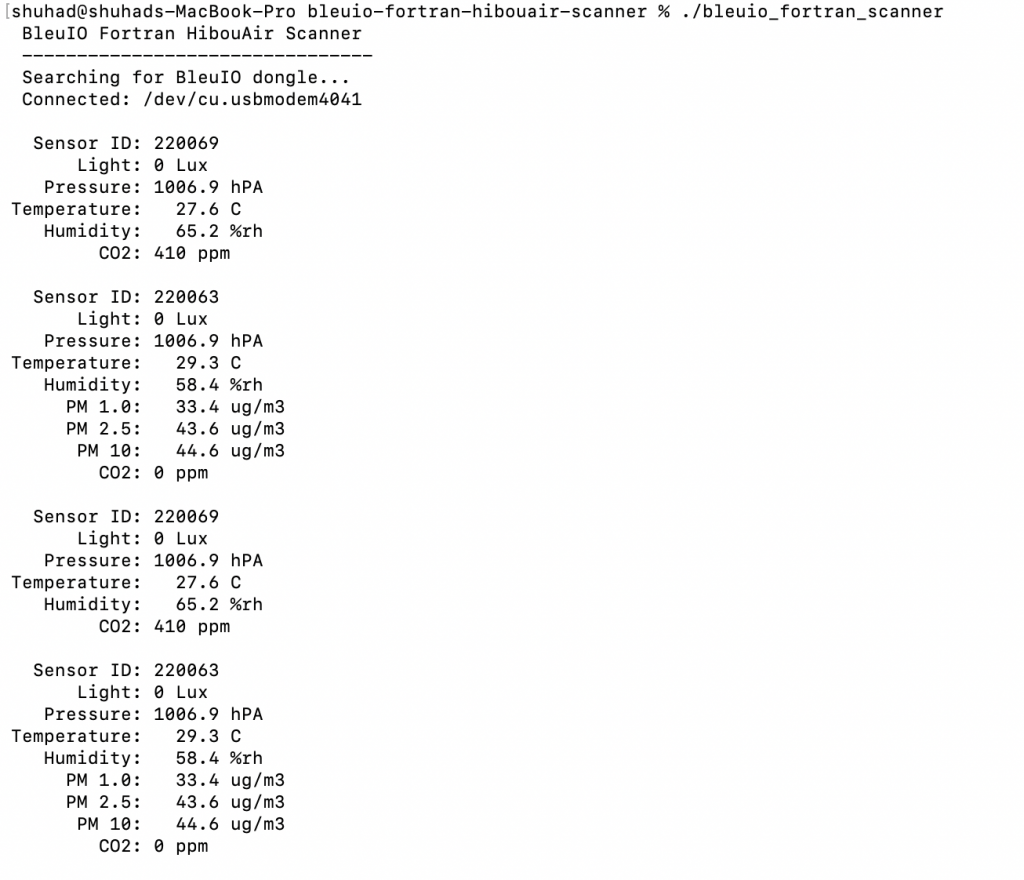
When the application is running, it prints decoded BLE sensor data directly to the terminal. Each detected broadcast from a matching device is processed and displayed in a readable format, making it easy to observe environmental data in real time.

About BleuIO

BleuIO plays a central role in this project by abstracting the complexity of BLE communication. Instead of implementing a full Bluetooth stack within the application, developers can interact with BLE devices using simple AT commands over a serial interface. This approach allows BLE functionality to be integrated into applications written in virtually any programming language and run on any major operating system. By handling scanning, filtering, and communication at the hardware level, BleuIO enables developers to focus on application logic, making BLE development faster and more accessible.

This tutorial demonstrates how Zig and BleuIO can be combined to build a practical BLE application with minimal overhead. While HibouAir is used here as a sample device for testing, the same approach can be applied to a wide range of BLE-enabled sensors and devices. The combination of a lightweight programming language and a simple BLE interface creates a powerful development workflow that is both efficient and easy to extend for real-world use cases.

Share this post on :

Building a BLE Sensor Scanner with Nim and BleuIO

Working with Bluetooth Low Energy devices often means dealing with multiple layers—hardware, protocols, and data decoding. In this tutorial, we are going to simplify that process by building a small command-line application using Nim and a BleuIO USB Dongle.

The goal is simple: scan nearby BLE devices, detect HibouAir sensors, decode their broadcast data, and display readable environmental values directly in the terminal.

By the end, you will have a working local tool that reads real-time air quality data without needing cloud connectivity.

What We Are Building

In this project, we build a lightweight desktop utility that connects to a BleuIO dongle and continuously scans for BLE advertisement data. When a compatible HibouAir device is detected, the application decodes the raw hex payload and prints meaningful values such as temperature, humidity, pressure, CO2, and particulate matter levels.

This is not a heavy application or a full dashboard. It is intentionally simple. The idea is to give developers a clean starting point to understand how BLE data flows from a device to a readable format.

Why Nim with BleuIO?

Nim is a compiled programming language that feels lightweight but powerful. It combines the simplicity of scripting languages with the performance of C. For developers who want fast execution, low memory usage, and clean syntax, Nim is a very practical choice.

Using Nim with BleuIO makes the development process even smoother. The BleuIO dongle abstracts away complex BLE stack handling and exposes everything through simple AT commands over a serial interface. Instead of dealing with platform-specific BLE APIs, you can send commands and receive structured data in return.

This combination allows you to focus more on logic and less on low-level Bluetooth complexity.

Requirements

Before running the project, make sure you have the following:

How the Project Works

When the application starts, it first looks for the connected BleuIO dongle by checking the USB device identifiers. Once the dongle is found, the program opens the serial port and prepares the device for communication.

The setup phase uses a short sequence of AT commands:

ATV0
ATE0
ATV1

These commands are used to configure how the dongle responds over serial so that the application can read and process the output more reliably.

After setup, the application starts scanning for BLE advertisement data using this command:

AT+FINDSCANDATA=FF5B07

This tells BleuIO to scan and report advertisement packets that match the data pattern used by HibouAir devices.

As scan results come in, the program reads the serial output line by line. It looks for valid scan data entries and then extracts the raw advertisement payload. Once a matching payload is found, the Nim code decodes the hex data into readable sensor values such as temperature, humidity, pressure, CO2, and particulate matter values depending on the device type.

When you stop the program with Ctrl + C, it also sends a final reset command to close things down cleanly:

ATR

Example Output

Below is an example of how the data appears in the terminal when a device is detected and decoded.

You will see values like temperature, humidity, pressure, and CO2 being printed in real time as the device broadcasts data.

Source Code

You can access the full project source code here:

[GitHub Repository ]

The code is intentionally kept small and readable so it is easy to follow and modify.

Running the Project

Once the project is downloaded and the BleuIO dongle is plugged into your Mac, you can build and run it directly from Terminal.

First, move into the project folder:

cd ~/Downloads/bleuio-nim

If you have not already installed the required tools, install them with Homebrew:

brew install nim libserialport pkg-config

After that, build the project:

nimble build

Once the build is complete, run it with:

nimble run

If everything is set up correctly, the application will detect the connected BleuIO dongle, initialize it, and begin scanning for HibouAir advertisement data. Within a few seconds, you should start seeing decoded sensor readings appear in the terminal.

When you want to stop the scanner, press:

Ctrl + C

The application will then stop scanning, send its cleanup command, and close the serial connection.

This project is best seen as a foundation rather than a finished product. It shows how to connect to a BLE device, scan for advertisement data, and decode it into something useful.
From here, you can take it in many directions. You might want to store the data locally, send it to a cloud service, build a graphical dashboard, or integrate it into a larger system. Since the core BLE communication is already handled through BleuIO, extending the project becomes much easier.

Share this post on :

Introducing BleuIO Firmware v2.7.9.78: Improved Stability & Data Reliability

We’re pleased to announce the release of BleuIO Firmware v2.7.9.78, bringing important fixes and enhancements that improve both data handling and communication reliability. This update reflects our continued focus on delivering a stable and developer-friendly BLE experience.

Improved Handling of Large GATT Data

This release resolves an issue where GATT data transfers exceeding 475 bytes could become truncated. In certain cases, this truncation resulted in invalid JSON formatting, which could lead to parsing errors in applications relying on structured data. With this fix in place, BleuIO now handles larger payloads reliably, ensuring data integrity and consistency across your BLE workflows.

More Reliable USB Communication

We have also strengthened the reliability of USB CDC read and write operations. The firmware now performs stricter checks to confirm that the dongle is properly configured and not in a suspended state before initiating communication. This improvement reduces the likelihood of unexpected failures and ensures more predictable behavior in various operating conditions.

How to Update Your Firmware

Updating to the latest firmware is straightforward. You can download the latest release and follow the step-by-step instructions available in our official documentation at https://www.bleuio.com/getting_started/docs/firmware/. Alternatively, you can use the BleuIO web application to perform the update directly from your browser by visiting https://bleuio.com/bleuioapp/#/fw.

Both methods are designed to make the upgrade process quick and seamless.

We recommend upgrading to BleuIO Firmware v2.7.9.78 to take advantage of these improvements. Updating ensures your projects benefit from the latest fixes and performance enhancements.

Share this post on :

Learn Bluetooth LE the Practical Way with BleuIO and the New Bluetooth LE Unplugged™ Course

Bluetooth Low Energy powers everything from smart sensors to industrial systems, yet learning it often feels unnecessarily complex. Many developers get stuck dealing with SDKs, toolchains, and setup issues before even understanding the basics. The Bluetooth LE Unplugged™ course takes a different approach by focusing on simplicity and hands-on learning. It removes traditional barriers and allows learners to start working with BLE immediately using real hardware.

How This Course Supports the BleuIO Community

This course aligns perfectly with what BleuIO stands for—making BLE accessible. Instead of requiring embedded experience, it allows developers from different backgrounds to learn Bluetooth LE in a practical way. By using two BleuIO dongles, learners can clearly understand both central and peripheral roles, making the learning process more complete and intuitive.

BleuIO Makes BLE Easier to Understand

BleuIO simplifies BLE development by replacing complex setups with simple AT commands. This allows learners to focus on core concepts like scanning, connecting, and data exchange without getting lost in configuration. The instant feedback from commands makes BLE behavior easier to understand, which is especially valuable for beginners and rapid prototyping.

A Course Built by a Trusted Bluetooth Educator

The course is created by Mohammad Afaneh, a well-known name in the Bluetooth space with over 20 years of experience. His teaching focuses on breaking down complex topics into practical, easy-to-follow lessons. Combined with BleuIO hardware, this creates a strong balance between expert guidance and hands-on learning.

What Learners Will Actually Get

The course includes BleuIO dongles, so learners can start experimenting right away. It is structured across multiple tiers and provides early access to content, with hardware shipped quickly. Importantly, the dongles are not just for the course—they can be used later for real projects, testing, and development.

A Strong Fit for the Existing BleuIO Ecosystem

The course also connects well with the existing BleuIO ecosystem. After completing it, learners can continue building using BleuIO tutorials, documentation, and real project examples. This creates a smooth path from learning to real-world application.

This is more than just a course—it highlights how BleuIO can simplify Bluetooth development. It shows that BLE can be learned in a practical and approachable way without unnecessary complexity.

Bluetooth LE Unplugged™ offers a clear and hands-on path into BLE development. With expert instruction and BleuIO’s simplicity, it becomes much easier to understand and apply Bluetooth concepts. Whether you are new to BLE or looking to strengthen your knowledge, this course provides a practical starting point.

Ready to Get Started with Bluetooth LE?

Take the next step and learn Bluetooth LE the practical way with real hardware and expert guidance.
Join the Bluetooth LE Unplugged™ course and start building your skills today.

Share this post on :

Scanning BLE Devices with C++ and Boost Using the BleuIO Dongle

Bluetooth Low Energy (BLE) has become one of the most widely used wireless technologies for IoT devices, sensors, wearables, and industrial monitoring systems. Developers working with embedded systems, automation platforms, and hardware integration often rely on C++ because of its performance, low-level hardware access, and portability.

In this tutorial, we will create a simple command-line BLE scanning application using C++. The program connects to the BleuIO USB dongle through a serial port and sends AT commands to control Bluetooth operations. After starting the program, the user enters the number of seconds to scan, and the application instructs the BleuIO dongle to perform a BLE scan and print the detected devices directly in the terminal. This example demonstrates the basic workflow of communicating with BleuIO from a C++ application.

Why C++ and Boost Are Commonly Used for Bluetooth Development

C++ is widely used in Bluetooth and embedded development because it provides high performance and direct access to hardware interfaces such as serial communication. Many IoT gateways, embedded systems, and industrial applications rely on C++ to interact with sensors and wireless devices. To simplify development, developers often use the Boost libraries, which extend the C++ standard library with reliable cross-platform tools. In this tutorial we use Boost.Asio, which provides a portable and efficient way to handle serial communication and asynchronous input/output across different operating systems.

Requirements

Before starting this project, you should have the following:

Installing the Required Tools

macOS Setup

First install Xcode Command Line Tools, which provide the C++ compiler.

xcode-select --install

Next install Homebrew if it is not already installed.

/bin/bash -c "$(curl -fsSL https://raw.githubusercontent.com/Homebrew/install/HEAD/install.sh)"

Then install Boost:

brew install boost

You can verify the installation using:

brew --prefix boost

Windows Setup

On Windows you will need:

  • Visual Studio or MSVC compiler
  • Boost libraries

Steps:

  1. Install Visual Studio Community Edition
  2. Enable Desktop development with C++
  3. Download Boost from https://www.boost.org
  4. Extract Boost and configure it for your project.

Alternatively, Boost can be installed using vcpkg.

Have a look into the getting started guide on boost office page

https://www.boost.org/doc/user-guide/getting-started.html

Understanding How the Script Works

The example script uses Boost.Asio serial communication to interact with the BleuIO dongle.

The application works in several stages.

Serial Connection

The program opens a serial port connected to the BleuIO dongle.

serial_.open(port_name);

The serial port parameters are configured to match BleuIO’s default UART settings.

serial_.set_option(serial_port_base::baud_rate(57600));
serial_.set_option(serial_port_base::character_size(8));
serial_.set_option(serial_port_base::parity(serial_port_base::parity::none));
serial_.set_option(serial_port_base::stop_bits(serial_port_base::stop_bits::one));
serial_.set_option(serial_port_base::flow_control(serial_port_base::flow_control::none));

Asynchronous Serial Reader

The script uses an asynchronous reader to continuously listen for responses from the BleuIO dongle.

serial_.async_read_some(...)

Whenever the dongle sends data, the program prints the received information to the terminal.

This allows us to see scan results in real time.

Sending AT Commands

Commands are sent to BleuIO using the sendCommand() function.

bleuio.sendCommand("AT+CENTRAL");

The command is written to the serial port followed by a carriage return and newline.

Setting Central Role

BLE devices can operate in different roles.
Before scanning, the BleuIO dongle must be set to central mode.

bleuio.sendCommand("AT+CENTRAL");

Starting a BLE Scan

The scan command is then issued.

AT+GAPSCAN=<seconds>

For example:

AT+GAPSCAN=5

This instructs the BleuIO dongle to scan for nearby BLE devices for five seconds.

The dongle returns advertising data for detected devices during the scan.

Full Source Code

You can find the full source code on GitHub.

GitHub repository

https://github.com/smart-sensor-devices-ab/bleuio-cpp-boost

The repository contains the complete C++ script used in this tutorial.

How to Run the Script

First compile the program.

clang++ -std=c++17 main.cpp -I$(brew --prefix boost)/include -o bleuio_scan

After compilation, run the program:

./bleuio_scan

The program will ask for the scan duration.

Example:

Enter scan duration in seconds: 5

The script will then:

Connect to the BleuIO serial port,Put the dongle into central mode,Start scanning for BLE devices,Print scan results in the terminal

Example output may look like this:

Locating the BleuIO Serial Port

Before running the program, you need to identify the serial port where the BleuIO dongle is connected.

On macOS, you can list available serial devices using the terminal command:

ls /dev/cu.*

The BleuIO device will typically appear with a name similar to:

/dev/cu.usbmodemXXXXXXXX

This value can then be used in the script as the serial port path.

On Windows, the serial port can be identified through Device Manager. After plugging in the BleuIO dongle, open Device Manager and expand the Ports (COM & LPT) section. The device will appear as a USB serial device with a COM port number, such as COM17.

Expanding This Example

The script in this tutorial is a basic example showing how to communicate with the BleuIO dongle using C++ and Boost.Asio. Although it only performs BLE scanning, the same approach can be used to send any AT command supported by BleuIO. Developers can extend this example to connect to devices, read GATT characteristics, parse advertisement data, or integrate BLE functionality into larger applications such as IoT gateways, monitoring tools, or automation systems.

Share this post on :

Integrating BleuIO with Teensy 4.1 – Scanning and Decoding HibouAir Sensor Data (Part 2)

In the previous project, we focused on getting Teensy 4.1 working as a USB Host for the BleuIO. The goal was simple: remove the PC from the equation and prove that a microcontroller could directly control BleuIO and communicate over BLE using AT commands.

This project builds on that foundation and does something practical with it. Instead of manually sending commands and observing responses, we now create a complete scanner that automatically detects nearby HibouAir sensors, reads their BLE advertisement data, decodes it, and prints meaningful environmental values in real time.

At this point, the system stops being a connectivity demo and becomes an actual application.

Hardware Requirements

Software Requirements

Install ArduinoJson

This project uses ArduinoJson to parse scan results from BleuIO.

In Arduino IDE:

  1. Open Library Manager
  2. Search for arduinojson
  3. Install version 7.x or compatible

ArduinoJson is required to deserialize the JSON scan data received from BleuIO.

How it Works

The architecture remains the same as in Part 1, but now it is used with purpose.

Teensy operates in USB Host mode and communicates directly with BleuIO. BleuIO handles all Bluetooth Low Energy scanning internally and outputs scan results as structured JSON strings over USB serial. Teensy receives those strings, parses the JSON content, extracts the manufacturer-specific payload, and decodes it into usable values.

Conceptually, the flow looks like this:

Teensy 4.1 (USB Host + Application Logic)

BleuIO (BLE Scanning Engine)

BLE Advertisement Data (JSON)

HibouAir Decoder

Readable Environmental Measurements

The important thing to notice here is that Teensy never deals with BLE packets directly. There is no radio handling, no GAP or GATT management, and no BLE stack integration. Everything related to Bluetooth stays inside BleuIO. The microcontroller simply receives structured scan results and processes them like any other data stream.

Automatic Startup and Scanning

When the firmware starts, it configures BleuIO automatically. It disables command echo, enables verbose mode, and then sends a filtered scan command:

AT+FINDSCANDATA=FF5B07

This tells BleuIO to report only devices containing the HibouAir manufacturer identifier. From that moment, scan results begin arriving continuously as JSON lines.

Each line contains fields such as the device address and a data field containing the manufacturer payload in hex format. That hex string is where the sensor readings are encoded.

Parsing the JSON Data

Since scan data arrives asynchronously, the project includes a small USB serial line reader. It buffers incoming characters until a newline is detected, ensuring that we always attempt to parse complete JSON messages.

The ArduinoJson library is used to deserialize each line into a JsonDocument. Once deserialized, we check that the expected scan fields are present. If so, we extract the hex-encoded manufacturer payload and pass it to the HibouAir decoder.

At this stage, the data is still raw — just a long hex string representing packed bytes from the BLE advertisement.

Decoding the HibouAir Advertisement Payload

The core of this project is the HibouAir structure. Instead of manually extracting bytes in the main loop, the decoding logic is encapsulated in a dedicated class.

The constructor receives the JSON document, extracts the data field, and interprets the hex string as a packed binary structure. Using offsetof() ensures that the correct byte offsets are used, and helper functions convert the hex pairs into integers. Because the BLE advertisement uses little-endian ordering, some fields require byte swapping before they become meaningful.

Once decoded, the class provides clean accessor functions such as:

  • getTemp()
  • getHum()
  • getBar()
  • getCo2()
  • getPM2_5()

These functions already return properly scaled values. For example, temperature is divided by 10 to convert from raw integer format to degrees Celsius.

This separation keeps the application logic simple. The main loop only needs to create a HibouAir object and call show_sensor() to print the values.

Example Output

When running the project with a nearby HibouAir sensor, the Serial Monitor shows structured environmental readings like this:

Sensor ID: 22008C
Light: 14 Lux
Pressure: 1007.3 hPA
Temperature: 22.9 C
Humidity: 14.1 %rh
CO2: 508 ppm

For particulate matter devices, additional values appear:

PM 1.0: 0.0 ug/m3
PM 2.5: 1.2 ug/m3
PM 10: 2.5 ug/m3

This output is generated directly from BLE advertisements without establishing a connection to the sensor. The sensors simply broadcast their measurements, and the system passively collects and decodes them.

GitHub Repository

The complete source code for this project is available here:

https://github.com/smart-sensor-devices-ab/bleuio-teensy-hibouair-scanner

You can clone the repository, install the ArduinoJson library through the Arduino IDE Library Manager, upload the sketch to Teensy 4.1, and run it immediately. The code is modular and organized so you can reuse the USB line reader, the HibouAir decoder, or the scanning logic in your own applications.

With this foundation in place, several natural extensions become possible. You could store measurements on an SD card, publish them via MQTT, expose them through a REST interface, or even build a complete air-quality gateway. The BLE side does not need to change.

Share this post on :

Integrating BleuIO with Teensy 4.1 for Seamless BLE Applications

In this project, we will show how to integrate BleuIO with Teensy 4.1 to create Seamless BLE Applications. The goal is to turn the Teensy into a USB Host controller that communicates directly with BleuIO through a simple Arduino sketch, allowing us to create BLE applications without implementing a full BLE stack on the microcontroller.

By the end of this project, you will have a fully functional embedded BLE platform where Teensy 4.1 acts as the application controller and BleuIO handles all Bluetooth Low Energy communication internally. You will be able to send AT commands from Teensy to scan for BLE devices, connect to them, read characteristics, and build your own BLE-based solutions. More importantly, you will gain a reusable architecture that can serve as the foundation for industrial gateways, IoT devices, monitoring systems, or custom embedded products.

Why We Chose Teensy 4.1

The Teensy 4.1 is built around the powerful NXP i.MX RT1062 ARM Cortex-M7 processor running at 600 MHz. This makes it one of the fastest microcontrollers compatible with the Arduino ecosystem. Its high clock speed, large memory capacity, and hardware floating point support allow it to handle complex logic, real-time data processing, and communication tasks with ease.

What makes Teensy 4.1 particularly ideal for this project is its USB Host capability. Since BleuIO is a USB device, it requires a host controller to operate independently of a PC. Teensy 4.1 provides exactly that. It allows us to connect BleuIO directly to the microcontroller and build a fully standalone BLE system. The board’s performance headroom ensures stable communication, fast response handling, and scalability for advanced applications.

Rather than choosing a minimal low-power MCU, we selected Teensy 4.1 because it bridges the gap between traditional microcontrollers and more complex application processors. It gives developers flexibility, speed, and reliability in embedded BLE projects.

Project Requirements

To build this project, you will need:

Project Architecture Overview

The system architecture is straightforward. Teensy 4.1 operates as a USB Host and communicates directly with the BleuIO dongle over serial. BleuIO then manages all Bluetooth Low Energy communication with nearby BLE devices. This separation of responsibilities simplifies development significantly. Teensy focuses on application logic, while BleuIO handles the BLE stack internally.

Teensy 4.1 (USB Host)
        ↓
BleuIO USB Dongle
        ↓
BLE Devices

How the Project Works – Step-by-Step

Step 1: Install Arduino IDE and Teensy Support

First download the Arduino 2.x.x IDE from Arduino’s website. All versions 2.0.4 and later are supported. Versions 2.3.0 or later are recommended, due to improvements in Boards Manager. 

To install Teensy on Arduino IDE 2.x, click File > Preferences (on MacOS, click Arduino IDE > Settings). 

In the main Arduino window, open Boards Manager by clicking the left-side board icon, search for “teensy”, and click “Install”. 

Step 2: Configure USB Type

Teensy supports multiple USB configurations. Under Tools → USB Type, select the appropriate mode so the board can manage serial communication while operating with USB Host functionality. Teensyduino is also compatible with many Arduino libraries

Step 3: Upload the Sketch

The source code for this project, USBtoUSBHostSerial.ino sketch, is publicly available on GitHub: https://github.com/smart-sensor-devices-ab/bleuio_Teensy_host

Upload the provided USBtoUSBHostSerial.ino sketch to the Teensy 4.1 using the Arduino IDE. This sketch initializes the USB Host interface and establishes a communication bridge between the Teensy and the BleuIO dongle. Once programmed, the Teensy essentially becomes a serial terminal for BleuIO, allowing you to type AT commands through the Arduino Serial Monitor and receive responses in real time.

Instead of embedding complex BLE logic in the microcontroller firmware, the sketch focuses on maintaining stable USB communication and forwarding user commands to the dongle. BleuIO processes these commands internally and returns structured responses. This design keeps the firmware clean, modular, and easy to expand.

Why This Approach Is Powerful

Developing BLE applications directly on microcontrollers traditionally requires integrating a BLE stack, managing connection states, handling security layers, parsing protocol events, and debugging complex timing issues. This process can be time-consuming and hardware-dependent. Each microcontroller family often requires a different SDK, stack configuration, and maintenance strategy.

By using BleuIO, this complexity is dramatically reduced. BLE functionality is abstracted behind a simple AT command interface. The microcontroller does not need to manage low-level BLE operations. Instead, it communicates using straightforward serial commands while BleuIO takes care of scanning, connecting, reading characteristics, and maintaining protocol compliance internally. This modular architecture makes the system portable across hardware platforms and reduces firmware complexity, development time, and maintenance effort.

GitHub Repository

The source code for this project, USBtoUSBHostSerial.ino sketch, is publicly available on GitHub:

https://github.com/smart-sensor-devices-ab/bleuio_Teensy_host

This project is shared as a public example to demonstrate how BleuIO can be integrated into high-performance embedded systems. It is intentionally simple in structure so that developers can clearly understand the architecture and reuse it in their own applications.

By combining the computational power of Teensy 4.1 with the modular BLE capabilities of BleuIO, we created a clean and scalable embedded architecture. This project highlights how BLE integration does not need to be complicated. With the right approach, developers can focus on innovation and application logic rather than low-level protocol management.

Share this post on :

Expanding the BleuIO Ecosystem with New Companion Products

At BleuIO, our goal has always been to make Bluetooth Low Energy (BLE) development, testing, and prototyping as smooth and accessible as possible. Many of our users are already familiar with how easy it is to purchase and start working with BleuIO dongles directly from our website.

Now, we are excited to take this one step further.

In addition to BleuIO dongles, you can now also purchase Close Beacon and a USB Type-C adapter directly from our store. These additions are designed to complement BleuIO perfectly and support developers working with modern hardware and real-world BLE use cases.

BleuIO has become a trusted choice for developers working with Bluetooth Low Energy. Its simplicity, stability, and flexibility make it suitable for everything from early prototyping to advanced testing and validation. Developers rely on BleuIO to scan, monitor, and interact with BLE devices during development, helping them better understand signal behavior, performance, and communication reliability.

By extending our product offering, we aim to support not only the core BLE interface but also the surrounding tools developers need for efficient workflows and realistic testing.

Close Beacon

Close Beacon is a Bluetooth device that continuously transmits its unique identity, making it especially valuable for developers working with beacon-based applications. When used alongside BleuIO, Close Beacon enables realistic testing of proximity detection, presence awareness, and location-based interactions. Combined with BleuIO, Close Beacon provides a practical way to simulate real-world beacon deployments during development and validation.

USB Type-C Adapter

As laptops and workstations continue to evolve, many modern devices now rely exclusively on USB Type-C ports. This shift can introduce challenges when working with traditional USB-based development tools. To address this, we now offer a USB Type-C adapter that ensures smooth connectivity between BleuIO and newer computers.

The adapter allows developers to connect BleuIO without additional configuration, maintaining a simple and efficient workflow. Whether working in an office, lab, or remote environment, the adapter ensures that BleuIO remains compatible with the latest hardware platforms and development setups.

With the addition of Close Beacon and the USB Type-C adapter, the BleuIO store now offers more than just a BLE dongle. Developers can assemble a complete toolkit for Bluetooth Low Energy development, testing, and experimentation directly from our website.

Share this post on :

Python Library v1.7.4 Released for BleuIO

We are pleased to announce the release of BleuIO Python library v1.7.4, a stability-focused update that improves logging clarity and, most importantly, significantly enhances how applications recover from unexpected dongle disconnections.

This release is designed to make long-running Python applications more reliable when working with BleuIO dongles in real-world environments.

Compatibility

Python library v1.7.4 is tested and verified with the following firmware versions:

  • BleuIO Standard: v2.7.9.51 or later
  • BleuIO Pro: v1.0.5.6

Note: This library version does not support firmware 2.2.0 or earlier on BleuIO Standard (SSD005).

What’s New in v1.7.4

This release introduces a refinement to the logging system used by the Python library. Previously, many internal messages were logged at the INFO level, which could result in excessive output in production environments. In version 1.7.4, all such messages have been moved to the DEBUG level, except for the firmware version message, which remains at the INFO level. This change provides a cleaner default log output while still allowing developers to access detailed diagnostic information when debug logging is enabled.

Reliable Recovery After Dongle Disconnection

The most significant improvement in Python library v1.7.4 is a fix for an issue related to recovering from lost communication with the BleuIO dongle. In earlier versions, the library could encounter problems if the dongle was unplugged, reset using the ATR command, or disconnected due to a crash or system error. In such cases, applications often required a full restart to regain communication.

This issue has now been resolved. When communication with the dongle is lost, the library raises a clear and consistent exception, BleuIOException: Port to BleuIO is not open. This allows applications to detect the failure immediately and implement recovery logic without terminating the program.

Exception Handling and Reconnection Example

With the improved error handling in this release, developers can catch the exception raised when the port is no longer available and reinitialize the BleuIO object to restore communication. The example below demonstrates how an application can continuously query the dongle, detect a disconnection, and automatically reconnect once the dongle becomes available again.

from bleuio_lib.bleuio_funcs import BleuIO
import time


my_dongle = BleuIO()
dongle_connected = True
while 1:
    try:
        print(my_dongle.ati().Rsp)
        time.sleep(2)
    except Exception as e:
        if "Port to BleuIO is not open!" in str(e):
            print("Error communicating with dongle: ", e)
            dongle_connected = False
            while not dongle_connected:
                try:    
                    my_dongle = BleuIO()
                    dongle_connected = True
                    print("Reconnected to dongle")
                except Exception as e:
                    print("Reconnection failed: ", e)
                    time.sleep(2)
                    pass

Example Output

[{'R': 7, 'dev': 'Smart Sensor Devices', 'hw': 'DA14683 (P25Q80LE)', 'name': 'BleuIO'}, {'R': 7, 'fwVer': '2.7.9.55', 'gap_role': 'dual'}, {'R': 7, 'connected': False, 'advertising': False}]
[{'R': 8, 'dev': 'Smart Sensor Devices', 'hw': 'DA14683 (P25Q80LE)', 'name': 'BleuIO'}, {'R': 8, 'fwVer': '2.7.9.55', 'gap_role': 'dual'}, {'R': 8, 'connected': False, 'advertising': False}]
Error processing serial data: ClearCommError failed (OSError(22, 'The I/O operation has been aborted because of either a thread exit or an application request.', None, 995))   <------------- When I pulled out dongle and plugged it in again
Traceback (most recent call last):
  File "C:\Users\emil\AppData\Roaming\Python\Python38\site-packages\bleuio_lib\bleuio_funcs.py", line 387, in __poll_serial
    self.rx_buffer += get_data()
  File "C:\Users\emil\AppData\Roaming\Python\Python38\site-packages\serial\serialutil.py", line 652, in read_all
    return self.read(self.in_waiting)
  File "C:\Users\emil\AppData\Roaming\Python\Python38\site-packages\serial\serialwin32.py", line 259, in in_waiting
    raise SerialException("ClearCommError failed ({!r})".format(ctypes.WinError()))
serial.serialutil.SerialException: ClearCommError failed (OSError(22, 'The I/O operation has been aborted because of either a thread exit or an application request.', None, 995))
Serial exception in polling thread: ClearCommError failed (OSError(22, 'The I/O operation has been aborted because of either a thread exit or an application request.', None, 995))
Traceback (most recent call last):
  File "C:\Users\emil\AppData\Roaming\Python\Python38\site-packages\bleuio_lib\bleuio_funcs.py", line 387, in __poll_serial
    self.rx_buffer += get_data()
  File "C:\Users\emil\AppData\Roaming\Python\Python38\site-packages\serial\serialutil.py", line 652, in read_all
    return self.read(self.in_waiting)
  File "C:\Users\emil\AppData\Roaming\Python\Python38\site-packages\serial\serialwin32.py", line 259, in in_waiting
    raise SerialException("ClearCommError failed ({!r})".format(ctypes.WinError()))
serial.serialutil.SerialException: ClearCommError failed (OSError(22, 'The I/O operation has been aborted because of either a thread exit or an application request.', None, 995))
Error communicating with dongle:  Port to BleuIO is not open!  <-------------  Here I catch the exception and handle it
No BleuIO dongle COM port available!
Reconnection failed:  No BleuIO dongle COM port available!
No BleuIO dongle COM port available!
Reconnection failed:  No BleuIO dongle COM port available!
No BleuIO dongle COM port available!
Reconnection failed:  No BleuIO dongle COM port available!
Reconnected to dongle  <----------------------- Bootloader exits and the BleuIO COM port is available
[{'R': 2, 'dev': 'Smart Sensor Devices', 'hw': 'DA14683 (P25Q80LE)', 'name': 'BleuIO'}, {'R': 2, 'fwVer': '2.7.9.55', 'gap_role': 'dual'}, {'R': 2, 'connected': False, 'advertising': False}]
[{'R': 3, 'dev': 'Smart Sensor Devices', 'hw': 'DA14683 (P25Q80LE)', 'name': 'BleuIO'}, {'R': 3, 'fwVer': '2.7.9.55', 'gap_role': 'dual'}, {'R': 3, 'connected': False, 'advertising': False}]

With this approach, your application can continue operating seamlessly even after unexpected interruptions.

Upgrade Recommended

Updating to Python Library v1.7.4 is quick and straightforward. If you already have a previous version installed, start by upgrading the package through pip. Run the following command in your terminal or development environment:

pip install --upgrade bleuio

This will fetch and install the latest version of the library.

Python library v1.7.4 is a reliability-driven update that delivers cleaner logging and robust recovery from connection loss. These improvements make BleuIO-based Python applications more stable, easier to maintain, and better suited for continuous and production-level use. We strongly recommend this update for all developers working with BleuIO in Python.

Share this post on :

Learn Bluetooth LE with BleuIO and Novel Bits

Bluetooth Low Energy can be challenging to learn and work with, especially when traditional development kits require complex SDKs, toolchains, and embedded firmware before you ever see your first result. BleuIO was created to remove that friction by allowing developers to interact with Bluetooth LE using simple, platform-independent AT commands. Through our collaboration with Novel Bits, learning and working with BleuIO is now even more accessible with practical educational resources, and faster access for U.S. customers, while continuing to support developers worldwide.

Getting Started with BleuIO: A Practical Guide

As part of this collaboration, Novel Bits has published a detailed “Getting Started with BleuIO” guide designed to help developers get up and running in minutes. The guide walks through connecting the dongle, issuing your first AT commands, scanning for nearby Bluetooth LE devices, and understanding advertising data-all without SDKs, embedded C, or complex toolchains.

The focus is on learning how Bluetooth LE actually works, using real hardware and clear, step-by-step explanations.

From First Commands to Advanced BLE Skills

For developers who want to go further, Novel Bits has also introduced a comprehensive hands-on course built around BleuIO hardware: Bluetooth LE Unplugged. The course takes a practical, hardware-first approach to learning BLE, allowing participants to explore both central and peripheral roles using two BleuIO dongles.

Rather than focusing on vendor-specific SDKs, the course emphasizes transferable Bluetooth LE knowledge that applies across platforms and products. Topics range from advertising and GATT fundamentals to security, automation, and packet-level analysis.

BleuIO Now Available with Fast U.S. Shipping Through Novel Bits

BleuIO continues to be available to developers and organizations worldwide through our global distribution channels. To better support customers in the United States, we’re pleased to share that BleuIO can now also be ordered directly from the U.S. via our authorized partner, Novel Bits. For U.S. customers, this means quick delivery, predictable shipping, and a smoother purchasing experience.

Whether you’re prototyping a new idea, testing devices at scale, or building a commercial product, BleuIO combined with Novel Bits’ educational resources gives you a fast and practical path forward.

Share this post on :