Common Bluetooth Low Energy Applications: Real-World Examples
BLE appears in products that measure, identify and control nearby things. The useful question is how each product moves its data.
What you’ll learn
- Recognize common BLE application patterns
- Separate advertising, connected GATT and gateway use cases
- Sketch a practical BLE monitoring system
One radio, several application patterns
A BLE product might broadcast an identifier, let a phone read a measurement, or receive a command while connected. These patterns have different needs for data size, timing, privacy and power. A product designer chooses a pattern first, then checks whether the intended phone, computer or gateway supports it.
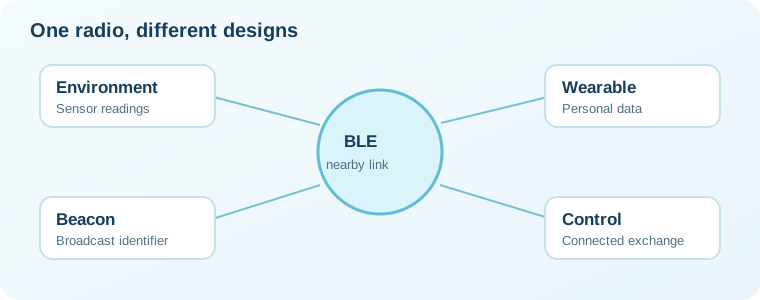
Environmental monitoring and wearables
An environmental sensor can measure temperature, humidity, CO₂ or other quantities. It may broadcast selected readings for a nearby receiver, or expose a GATT service for a connected app. Reporting interval and radio duty cycle affect battery use; the sensor still needs suitable calibration and a defined data format. A gateway can store measurements over time when users need a remote dashboard.
Heart-rate straps, activity trackers and other wearables often exchange measurements with a compatible phone or computer. Some use standardized Bluetooth services, while others define vendor-specific data. A receiver must interpret the right service and permissions. Wireless delivery does not establish clinical accuracy: health-related claims depend on the complete product and its validation.
Homes, workplaces and industrial sites
A smart lock may use a connected, authenticated exchange for a control action; a room sensor might only advertise periodic readings. A lighting controller can use BLE within a broader system. Security requirements, access management and behavior after a lost connection matter as much as radio range. Do not assume that detecting a lock in a scan grants the ability to unlock it.
Factories and facilities can collect local equipment readings or environmental measurements with BLE sensors. A nearby collector can reduce cabling, but engineers still need to test interference, enclosure effects, missed packets, maintenance, device identity and data retention. Where data must reach a remote system, a gateway or other network path is required.
Beacons, retail and agriculture
A beacon repeatedly advertises an identifier or small payload. Receivers can notice its presence and record received signal strength (RSSI). RSSI varies with obstacles, antenna orientation and radio noise; it is not a precise distance or guaranteed location measurement. Asset systems usually combine observations with site rules, receiver placement and software.
Retail systems can use BLE for local proximity interactions or inventory observation when users and devices have the right receiver and permissions. Electronic shelf equipment may use BLE, but designs differ. On a farm, BLE may collect measurements from a sensor near a vehicle or collection point. It does not by itself provide wide-area coverage across remote fields; the receiver still has to reach each sensor and forward the data.
Custom electronics and published BleuIO projects
Developers combine BLE-capable microcontrollers, computers, sensors and gateways in many ways. A BleuIO dongle adds a documented BLE interface over USB to a host application, which can observe advertisements or use supported connected operations. The host software decides how to decode and display data.
HibouAir to MQTT
A HibouAir air-quality sensor broadcasts data. BleuIO receives it, and a JavaScript project forwards decoded readings to an MQTT broker. This shows the boundary between local BLE reception and network publishing.
Read the BleuIO project ↗Local air-quality dashboard
In a published Grafana project, BleuIO and a Python script collect HibouAir advertisements; the script decodes and stores measurements for visualization. BLE handles sensor-to-computer delivery, while the dashboard handles history.
Read the BleuIO project ↗Development-board gateway
A published RP2040/RP2350 project uses a USB-host board with BleuIO to receive HibouAir advertisements and present readings through a browser interface. It illustrates that the board needs USB-host support and application firmware, not just a plugged-in radio.
Read the BleuIO project ↗Design a simple monitoring system
Imagine a room sensor that measures temperature, a nearby computer with a BleuIO dongle, and a dashboard. The sensor collects the measurement and sends it using BLE. BleuIO receives the radio data. Software on the computer decodes it and either displays it locally or forwards it to a database. The dashboard shows the latest value and history. No Internet connection is necessary for local display; remote viewing needs another network path.
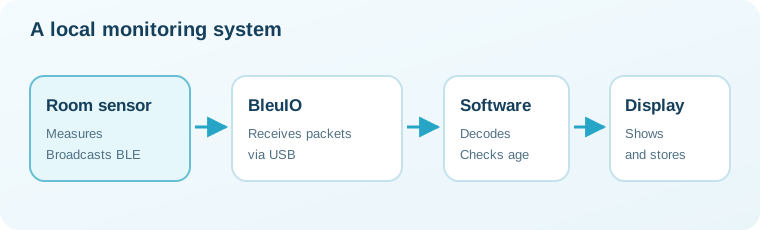
Choose one measurement. Decide whether it belongs in an advertisement or needs a connected GATT characteristic. Identify the receiver, the data format, where history will be stored, and how you would notice stale readings. Then compare your design with the diagram. To see advertisements before building software, visit the BleuIO Web App scanning lab.
You’ve completed the BLE fundamentals
You can now explain what BLE is, why it differs from Bluetooth Classic, how advertising and optional connections work, and what central, peripheral, broadcaster and observer mean. You have also compared BLE with other wireless choices and seen where real products use it.
Next: BLE Architecture and Communication. The first architecture lesson opens the stack behind those behaviors: application, Host, HCI and Controller. Mark this lesson complete below to save your Module 1 progress in this browser.
Check your understanding
In the monitoring system above, which component decodes BLE bytes into a dashboard value?
Key takeaways
- BLE applications may use advertising, connected GATT operations or both.
- A local receiver or gateway can turn BLE observations into stored or displayed data.
- Real deployment needs attention to security, signal conditions, data formats and stale readings.
Further Reading and Resources
Save your progress in this browser.