BLE vs Wi-Fi, Zigbee and NFC: Understanding Wireless Technologies
A sensor, a video camera, a lighting network and a payment card solve different communication problems. Their radios should reflect those differences.
What you’ll learn
- Compare four wireless technologies without relying on fixed range or battery-life claims
- Choose a technology from the needs of a real project
- Explain how BLE and a network gateway can work together
Start with the job, not the radio
Wireless standards make different trade-offs. A battery sensor might send a few bytes every minute; a security camera must move a steady stream of video; a payment card needs a deliberate, close interaction. A technology suitable for one is not automatically suitable for the others.
Before comparing product names, write down how much data must move, how often, how far, and where it must go. Also ask which devices must understand it. A phone with BLE support does not, by itself, join a Zigbee network, and a BLE dongle does not become a Wi-Fi or NFC radio.
What should you compare?
Power depends on radio activity, hardware and firmware; a low-power label is no battery-life guarantee. Throughput means useful data delivered over time, while latency is how long an action takes to receive a response. A small sensor report and live video place very different demands on both.
Range is shaped by antenna design, obstacles, interference and the selected radio mode. Topology describes who talks to whom: a nearby device, an access point, or nodes relaying across a mesh. Infrastructure might mean a phone, a USB gateway, a Wi-Fi access point or a Zigbee coordinator. Finally, check interoperability, security, development effort and total system cost: a familiar radio name does not guarantee that two products share an application protocol.
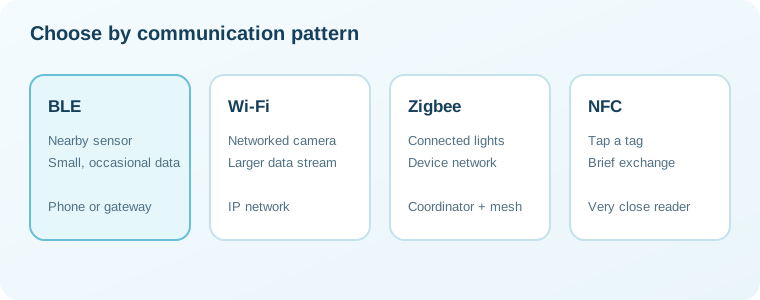
How the four technologies differ
Bluetooth Low Energy
BLE is a strong candidate when nearby devices exchange modest amounts of data and can spend much of their time idle. An advertiser may broadcast a small value without a connection; a connectable peripheral can expose GATT data to a central such as a phone or computer. Smartphone compatibility helps with commissioning and local applications, but supported features and permissions vary. BLE is not a direct Internet link and is usually a poor match for sustained video.
Wi-Fi
Wi-Fi commonly joins devices to a local IP network through an access point. That makes it useful when an application needs established network infrastructure or substantial data transfer, such as a camera sending video. Continuous Wi-Fi activity can require more energy than an intermittently active BLE sensor. This is a design comparison, not a universal ranking: Wi-Fi variants and power-saving implementations differ.
Zigbee
Zigbee is a separate low-power device-networking technology. A Zigbee network has a coordinator that starts it; routers can relay traffic in a mesh, while end devices may sleep. That can suit lighting and building automation across many nodes. A Zigbee product needs a compatible Zigbee ecosystem and often a bridge to a phone or IP network. Zigbee is not a BLE profile.
NFC
Near Field Communication is designed around very close, intentional interactions: a phone taps a tag, card or reader. A passive tag can be powered by the reader field, so a simple tag need not have its own battery. NFC works well for tap-to-open, ticketing and contactless identification, but it is not a continuous room-scale sensor link.
Comparison at a glance
| Technology | Useful for | Power and data | Reach and network | Main trade-off |
|---|---|---|---|---|
| BLE | Nearby sensors, wearables, device setup | Can sleep between small exchanges; limited fit for sustained high data | Local advertising or connections; gateway needed for remote access | Application and phone support must be checked |
| Wi-Fi | IP-connected devices, cameras, large transfers | Often more energy for active high-throughput use; variants differ | Local network, usually through an access point | Network setup and energy budget |
| Zigbee | Automation networks with many devices | Low-power end devices; modest device data | Coordinator, with routers able to extend a mesh | Compatible network and bridge may be needed |
| NFC | Tap, tag and contactless transactions | Small exchanges; passive tags can be battery-free | Very close interaction, not a room-wide network | Requires an intentional tap |
These are design patterns, not universal speed, range or energy specifications. Versions, hardware, settings and the physical environment can change the result.
Choose for a real project
Nearby battery sensor: BLE is a sensible starting point if a computer or phone can receive short reports. Consider how often it advertises and whether its measurements fit in broadcast data or require GATT. Security camera: Wi-Fi is a more natural candidate for sustained video and IP access, provided power and network coverage are available.
Networked home lighting: Zigbee may suit a coordinated mesh of compatible lights and controllers. BLE can also be appropriate in some lighting systems; the existing ecosystem determines the choice. Tap-to-identify: NFC suits an intentional card or phone tap. BLE proximity alone would not give the same deliberate user action.
A warehouse wants a battery tag to report a small value to a nearby gateway every few minutes. Which technology would you shortlist first, and what would you verify? Start with BLE, then check range in the real building, battery budget, receiver compatibility and whether a gateway can forward the data. Zigbee could also fit if the site already operates a suitable mesh.
Combining technologies with a gateway
A gateway receives data over one link and forwards it over another. A BLE sensor might advertise a measurement; a nearby computer receives it through a BleuIO USB dongle, decodes it, then sends it to a server over its own Wi-Fi or Ethernet connection. The dongle supplies the BLE interface. The computer and its networking software provide the IP connection.
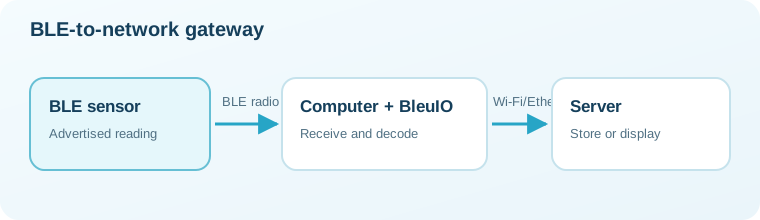
BleuIO is useful for developing and testing the BLE side of this design. Its documented AT commands let an application scan and interact with supported BLE devices. A published BleuIO MQTT project demonstrates sensor data crossing from BLE into an Internet messaging system. For a first observation of BLE itself, use the guided scanning lab.
Check your understanding
A camera must stream video to a local IP network. Which starting choice best fits that requirement?
Key takeaways
- Choose by data pattern, power, reach, network and interoperability rather than a single specification.
- BLE, Wi-Fi, Zigbee and NFC address different communication patterns; implementations vary.
- A gateway can receive BLE data and forward it over Wi-Fi or Ethernet.
Further Reading and Resources
Save your progress in this browser.