Using BleuIO as a BLE Gateway for Edge Computing Applications
January 6, 2026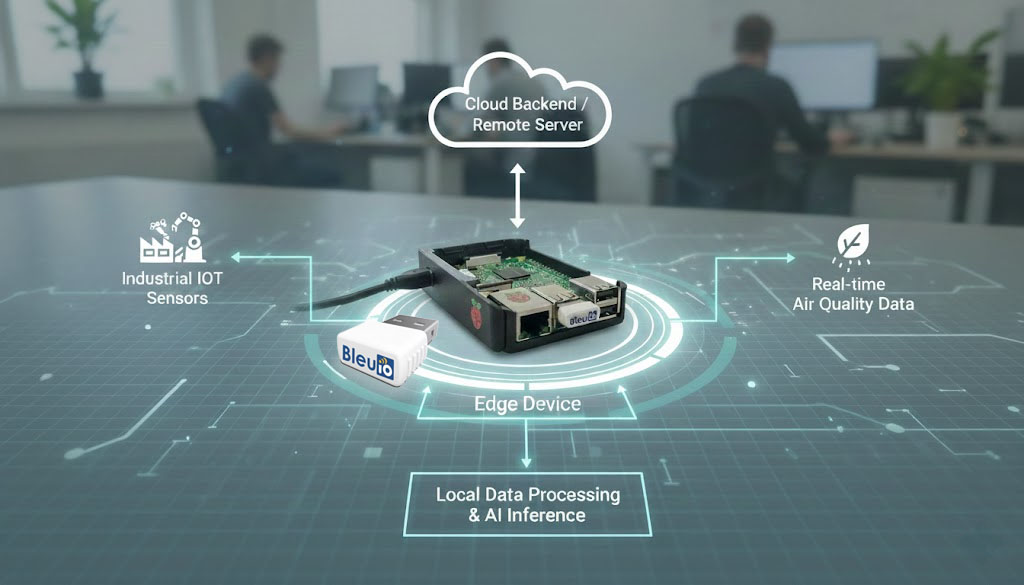
Bluetooth Low Energy has become one of the most widely used wireless technologies for sensors, beacons, and low-power devices. From environmental monitoring and asset tracking to smart buildings and industrial systems, BLE devices are now everywhere. At the same time, edge computing has emerged as a practical response to the limitations of cloud-only architectures.
The problem with cloud-only BLE architectures
Many BLE projects start with a simple idea: scan for BLE devices, collect data, and send everything directly to the cloud. While this works for small experiments, it often breaks down in real deployments.
One common issue is latency. BLE sensors often transmit small data packets at short intervals. When every packet is sent to the cloud, even small network delays can prevent timely reactions. This becomes critical in use cases such as environmental monitoring, industrial safety, or building automation, where immediate response matters.
Another challenge is network dependency. Cloud-centric designs assume constant internet connectivity. In factories, basements, temporary installations, or remote locations, connectivity may be unreliable or unavailable. When the connection drops, data collection and decision-making stop entirely.
There is also the issue of data overload and cost. Streaming raw BLE data continuously consumes bandwidth, increases cloud storage requirements, and complicates analytics. Much of this data is often repetitive or irrelevant until a threshold or anomaly appears.
These problems highlight the need for a smarter approach—one that processes BLE data closer to where it is generated.
How edge computing changes the equation
Edge computing moves data processing from the cloud to a local system, such as an industrial PC, a small server, or a single-board computer. Instead of acting as a simple relay, the edge system analyzes data in real time, applies rules, and decides what should happen next.
For BLE applications, this means:
- Immediate reaction to sensor changes without waiting for cloud responses
- Continued operation even when internet access is lost
- Reduced data volume sent to cloud platforms
- Better control over system behavior and reliability
Edge computing does not replace the cloud. Instead, it complements it by ensuring that only meaningful, processed information is forwarded for long-term storage, visualization, or reporting.
BleuIO as a BLE gateway at the edge
BleuIO plays a key role in this architecture by acting as the BLE interface between physical devices and edge intelligence. Connected via USB, BleuIO handles scanning, connecting, and communicating with BLE devices using a simple and predictable AT-command interface.
From the perspective of the edge application, BleuIO behaves like a stable BLE modem. The application does not need to interact with complex operating-system-level BLE stacks or vendor-specific SDKs. Instead, it can focus on logic, data processing, and integration.
This design is especially useful for long-running edge services, where reliability and consistency are critical. BleuIO’s behavior remains the same across platforms, making it suitable for deployments on macOS, Linux, and Windows systems.
Typical BLE edge gateway architecture
A typical edge gateway built with BleuIO follows a clear and modular structure.
BLE sensors or devices broadcast advertisement data or expose characteristics. BleuIO scans for these devices, filters relevant data, and passes it to the host system. The edge application decodes and processes the data locally, applying thresholds, aggregation rules, or control logic. Only selected events, summaries, or alerts are then forwarded to cloud services, dashboards, or databases.
This architecture keeps the BLE layer simple and reliable while allowing the edge layer to evolve independently as system requirements grow.
Use case
Smart building and indoor monitoring
In smart building environments, BLE sensors are often used to monitor indoor conditions such as air quality, occupancy, or equipment status. A cloud-only approach can delay responses to poor conditions, especially during network congestion or outages.
Using BleuIO as an edge gateway allows the system to react immediately. The edge application can continuously monitor BLE sensor data, detect when conditions deviate from acceptable ranges, and trigger local actions. Ventilation systems, alerts, or building management integrations can respond instantly, while summarized data is still sent to cloud dashboards for long-term analysis.
This approach improves occupant comfort, reduces response time, and lowers unnecessary cloud traffic.
Industrial monitoring and local automation
Industrial environments often present challenging conditions for wireless communication and cloud connectivity. BLE sensors may be used to track machine states, environmental parameters, or asset presence.
With BleuIO at the edge, BLE data can be filtered and analyzed locally. The edge system can identify abnormal patterns, trigger maintenance alerts, or activate control systems without relying on external connectivity. This is particularly valuable for safety-critical or time-sensitive operations.
By processing data locally, industrial systems gain resilience and predictability, even in harsh or isolated environments.
Temporary and offline deployments
Not all BLE projects are permanent installations. Temporary monitoring setups, field testing, and mobile deployments often lack stable internet access.
In these scenarios, BleuIO enables fully autonomous BLE gateways. The edge system can store data locally, apply logic, and operate independently for extended periods. When connectivity becomes available, data can be synchronized with cloud platforms or exported for analysis.
This flexibility makes BleuIO suitable for research projects, pilot deployments, and remote monitoring applications.
Solving common BLE gateway challenges
Many developers struggle with BLE gateways because of unstable OS-level BLE stacks, complex APIs, and inconsistent behavior across platforms. These issues become more pronounced in long-running edge applications.
BleuIO addresses these challenges by abstracting BLE complexity behind a simple command interface. This reduces development time, improves system stability, and makes automation easier. Developers can build gateways using familiar tools and languages while maintaining full control over BLE behavior.
How this approach scales well
Using BleuIO as a BLE gateway supports incremental system growth. Projects can start with local data processing and later add cloud integration, analytics platforms, or automation layers without redesigning the BLE foundation.
Because the edge application controls what data leaves the system, it is easier to comply with bandwidth limits, privacy requirements, and operational constraints. This makes the architecture suitable for both small deployments and large, distributed systems.
BleuIO as a foundation for modern BLE edge systems
Edge computing has become essential for reliable, responsive BLE applications. By combining local processing with selective cloud integration, systems gain speed, resilience, and scalability.
BleuIO fits naturally into this model. Acting as a stable BLE gateway, it bridges the gap between low-power wireless devices and edge intelligence. Whether the goal is smart buildings, industrial monitoring, or temporary deployments, using BleuIO at the edge enables practical, future-proof BLE solutions.